Showing posts with label GOTHIC movie. Show all posts

Saturday, April 15, 2017

New Gothic Movie Review: Crimson Peak


As you know, I adore Gothic literature. Anne Radcliffe, Jane Austen, Bram Stoker, Mary Shelley, and the new Gothic offerings of this generation of writers.  

Finding a Gothic Movie that's worth watching is another matter.  There are a lot of bad ones. 

I recently watched Crimson Peak, a new Gothic tale starring Tom Hiddleston (Loki), and Mia Wasikowski (Jane Eyre, Alice in Wonderland).  I missed it in the theater, and bought it a while back, but never managed to get around to watching it. I had bought season six of Downton Abbey along with this one, so of course I watched Downton first.

All I can say is  . . . . wow!  This is what a Gothic flick should be. 


The elements were all there, mysterious, dangerous love interest (Hiddleston), and the spooky, isolated home with an intriguing atmosphere that will bring chills---literally, as there is constantly snow or rain falling through the roof. Brrr.  You feel cold just watching Edith (Wasikowski) trying to find warmth in this odd and ill maintained Gothic mansion. Add to that the constant uncertainty about what is actually happening, the many ghostly appearances to Edith at the old manor, and the odd relationship between brother and sister, and you're kept on the edge of your seat. Something is very wrong at Allendale Estates, but you aren't sure what. The plot, and the danger is slowly revealed with very subtle and clever clues.

The story starts with Edith as a rich girl in America who wants to be a writer. It's about 1880. She's born into a wealthy home. Her father is a businessman and worked his way up from nothing, no silver spoon in his mouth. He's successful, and Edith lives in luxury in his well maintained, well staffed manor house.  Edith tells us in the opening segment that "Ghosts are real!"

She then goes on to share her one encounter with a ghost, her mother's ghost, after her mother's funeral. She was just a little girl when this occurred, and it's creepy scary. Mom appears, but in a state of decay, not the pretty type of ghosts we usually see. And this is where this movie is so unique for a Gothic Horror Romance.  The ghosts are UGLY, creepy and gross. They are scary because they are so ugly, they reflect their physical form, as in badly decayed and decomposed. But, I'm getting ahead of myself here.

Back to Edith, and the opening. After we are introduced to her world, rich girl, mother is dead, daddy is rich, we learn that she doesn't just want to go to dances like other young women her age and see and be seen. No, Edith has a passion, a dream. She wants to be a writer. She's written a manuscript, a ghost story, and her father arranges for her to see a publisher with it.  She goes, and is turned away, as the old gentleman suggests maybe she should write a romance, instead. Edith sighs and leaves, but continues to work on her manuscript at home.

She has a childhood friend who is a doctor, and he's sweet on her. She doesn't see him as anything but a friend, to his chagrin. A handsome stranger from England comes to her father's company asking for a loan, for support in an invention for mining that he needs backing for. This man is a baronet, Sir Thomas Sharpe. He charms Edith, and after a few meetings, he wants to marry her. But Daddy interferes, and then Daddy dies mysteriously.


Edith marries Sir Thomas, and goes to England to live at his estate. When you see the house, you'll be struck dumb with amazement!  The movie crew built this house just for the movie. It's not a movie set, its a bonafide Victorian mansion, complete with working bathrooms and an elevator. It's very, very Gothic!  Atmospheric as you've never encountered before. The house has a distinct personality.  As I said before, it's in disrepair. So our heroine, Edith, goes from a cozy mansion that is well maintained to a shoddy mansion where the roof is open and the weather actually comes in. Rain, snow, and what appears at times to be soot. Sir Thomas owns a mine, and the earth around his home is blood red. It's clay. The locals call the place Crimson Peak in the winter, as the red clay bleeds through the snow, giving the landscape an eerie feel. Blood red. There's a metaphor there.

Of course, Sir Thomas and his sister, Lucille, are hiding something sinister there at the old manor. They are the only ones at the home, aside from Edith. Strangely, there are no servants at the house, at least none shown in the movie, aside from Finlay, the outside servant. Lucille, the sister, is cold and distant. She constantly is making Edith tea, however, and after a while, you get a little creeped out by that. A little too eager to hand over a cup a tea whenever Edith is upset.

There is plenty to be upset about, by the way. Edith is in a strange land. Well, England, but this version of England is anything but welcoming. The landscape around the estate is stark. Nothing much grows, due to the red clay.  She's in a big, big house that is empty, save her husband and his sister, and the house is falling apart. It seems to be sinking slowly into the earth, a nod to Poe's Fall of the House of Usher here. The house actually groans at times, and pipes rattle. Edith is rattled. She can't put her finger on what is wrong with the place, or her new family. And then there are the ghosts who pop up and try to warn her. At least, after a while she and you will realize that's what they are doing. At first it seems they are just trying to scare her.

And make no mistake, Edith is in grave danger. Is it the house that is trying to harm her? Sir Thomas, who seems genuinely enthralled with her but has a deeper motivation for marrying her than love? Or is it that demented sister of his? Something is very wrong in this place, and if you love atmospheric Gothic Suspense and horror, you'll be thrilled.  As all good Heroines in Gothic Stories, Edith starts to investigate her surroundings, in secret, of course. She travels the dark corridors with candlestick in hand, fearful but determined to make sense of her situation.


Silver Lining;  Edith's childhood friend, the doctor, is suspicious over her father's death, and decides to investigate. We are told in an early segment that he likes Sir Arthur Conan Doyle's works, as in Sherlock Holmes. Will he arrive in time to save Edith from the horrors of Crimson Peak?

My rating:  A+.  There is so much to love about this flick!  Good storyline that is NOT too obvious. You'll be struggling to put together the pieces here, like a good mystery.  Stellar cast, EPIC setting and filming, and some pretty scary and creepy ghosts to keep you jumping out of your seat. Destined to become a classic.

If you'd like to see some to the set images, click the link below:

Image Gallery for the Movie Crimson Peak http://collider.com/crimson-peak-images/

Video Trailer:


Sunday, August 9, 2015

Lord Byron's Scandal

Meet a real Regency Rake in the Romantic Era of England: 


Lord Byron as a young man

"So beautiful a countenance ... his eyes the open portals of the sun--things of light and for light."  Coleridge describing Lord Byron's physical appeal.

As a young man, he was considered extraordinarily handsome (see image above) by women of the Romantic era. Think Johnny Depp, but in Regency times. He had sex appeal, and he had a serious brood factor.  (And Johnny Depp played a main character in a movie based one of his literary creations, more on that later!)

A Real Regency Rake? 

Lady Caroline
It is said that this Regency Rake was not a pursuer of women, but rather, they pursued him. He entered into a series of secret liaisons with ladies of the Ton, to the point where he married to get away from one desperate lover. Lady Carolyn Lamb was an eccentric, lovely yet flamboyant woman who caused him incredible stress and scandal with her public tantrums when they met at social gatherings. So, he married a woman who would be his former lover's opposite in temperament, Annabella Milbanke. His wife was a quiet, shy intellectual with a passion for mathematics, not the movements of Regency society. Of course, this would be a doomed marriage because George was a very social creature--also eccentric and a little flamboyant, much like his former lover, Lady Caroline. Lady Caroline Lamb was known to behave in odd ways, such as dressing up as a footman to go out and meet her lover. She was one of those drama queens who feed on creating a scene in public, and actually began stalking our Regency hero after he tired of her.

Scandalous Desires

Byron had money problems, even being a wealthy lord. He spent as much as he was worth and so in his domestic life he behaved so frantically his wife is said to have feared for his sanity. The union lasted only a year before it was ended by a legal separation. (Yes, dear readers, people with money and power could dissolve a marriage in this time period. Wasn't easy, and happened rarely due to the social burden of keeping up appearances, but it could be done.)

Johnny Lee Miller as Byron from BBC Film
The kicker for this legal separation has a real Eeewww factor!  Turns out, Annabella found out her husband was having a secret love affair with his half-sister. Even to the jaded palates of the Regency era, this was just too much to bear. It was a succulent scandal, but it was crossing a firm line in society. People could and did have secret affairs, both men and married women. As long as the lovers in question were discreet, an affair would be ignored by indulgent spouses. In the case of the woman, she had to be married, and once she produced an heir for her husband (so he knew the child was actually his) she might be given her freedom by an indulgent spouse. I know it sounds harsh and cold in our modern eyes but as many marriages were based on business transactions and convenience, not love, there were bargains made with spouses behind closed doors. 

Sorry, getting back to George, his wife and his half-sister lover...... in Byron's defense, it is possible he did not know his half-sister as they were raised separately and never truly met face to face until they were adults--and it is likely to assume he didn't realize they were related when they had their affair. It really didn't matter, as George Gordon, Lord Byron, was ostracized by the society who once adored him. He fled England forever, somewhat by force, it's rumored, on April 25th, 1816. 

"She walks in beauty, like the night . . . "  


                                             I bet you thought Shakespeare wrote that, it was Lord Byron. 


And so, Lord Byron traveled, a lot. And he wrote..... a lot. 
He may not seem like a romance hero to you but rather a womanizing rake, however, Lord Byron, our man George, has given us some incredible literature that stands the test of time. He was a romantic. And he rubbed elbows with the best literary figures of the times: Percy Shelley, Mary Shelley (Frankenstein), John Keats to name a few. His influence is everywhere. Many European poets struck what is called a 'Byronic Attitude', the solemn, serious brood factor. He created that in the sense of poets striking an attitude. He is also the inspiration for the term Byronic Hero

His longtime friend, Mary Shelley said of him: "Our Lord Byron is fascinating, faulty, childish, philosophical, daring to the world but docile to a private circle--impetuous and indolent--gloomy and yet more gay (happy & pleasant) than any other.

Lord Byron's Most Popular Works: 

Childe Harold's Pilgrimage, published in 4 installments called cantos, from 1812-1818, is a travelogue sort of poem. It is narrated by a passionate, well-read, slightly melancholy tourist. The term Childe is an ancient term used to describe a young noble awaiting knighthood. This journal is an accurate record of places in Europe seen during his travels, and it is written as a dramatic experience full of a passionate and sometimes volatile sensibility that depicts a new phenomenon in literature--The Romantic Man of Feeling. 

Don Juan, again, published in serial form as cantos 1 and 2 from 1818 to 1819. This is a famous story of an amiable young man who has charm, wit and a compliant spirit. (is it George in disguise?) He is pursued and loved by many women, one who keeps him in her harem and dresses him as a woman to hide him from her husband. And here is where Johnny Depp comes in  [smile]. 


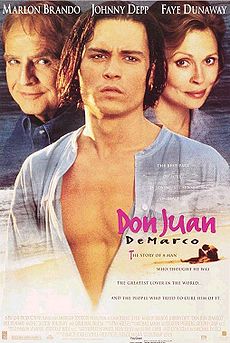
Few of you will remember an obscure film in the 1990's staring Marlon Brando, Faye Dunaway and a new star on the scene in 1994, Johnny Depp. Depp plays Don Juan de Marco, a modern man who believes he is the real life character of Lord Byron's famous story. I watched it back then, and had never heard of Johnny Depp before seeing this film. If you are looking for a romantic film in his early years, you'll love this. And, if you want to see the story of Don Juan in film, this is a good modernized version.  Don Juan de Marco Trailer


And if you would like a few more movies about Byron or featuring Byron's character, here is short list for you to search out: 


Richard Chamberlain as Lord Byron
This film (above) is called Lady Caroline Lamb, and was produced in 1973. I haven't seen it but if you like older movies, it might be worth looking up. No, it isn't black and white, it's in color.

And lastly, with a little embarrassment and chagrin, I'll share a movie from my shelf:
GOTHIC, made in 1986.

It's quirky, corny, and tries to be both a historical and a horror story. So, if you can tolerate some melodrama in a Regency era movie based on actual events that took place in Byron's life, go for it. Just know it's a little over the top and is good for laughs and entertainment rather than a bio film. It stars Gabriel Byrne as Lord Byron. The story is based on events that supposedly took place at Lord Byron's retreat in Lake Geneva, where he invited friends Percy and Mary Shelley and his lover, Claire Clairmont. They came up with an idea to try to create a ghost, and their results create psychological horror in the group as a result. It is said to be one of the reasons Mary Shelley came up with her story, Frankenstein, at least rumored. Watch it if you dare. The characterization of Byron is done well and Byrne is handsome and dashing in this. Beware, however, that there are some sexual scenes, and some disturbing scenes in it as it has chosen to be a horror flick first and a Regency second. 

Gabriel Byrne as Lord Byron in GOTHIC

Fun facts about Lord Byron's Life: 

  • His mother was Scottish; Catherine Gordon of Gight was the last descendant of a line of Lawless Scottish Lords. 
  • His father, Captain John Byron, was a rake and fortune hunter. 
  • His grandfather was an admiral nicknamed "Foulweather Jack"
  • His great uncle, the fifth Baron Byron, was known as the 'Wicked Lord" who killed his kinsman in a drunken duel. He was tried by his peers for the crime. 
  • Despite his stunning looks, George, Lord Byron, was born with a deformed foot that was made worse by a surgery gone wrong that caused him to be lame. This also brought him much embarrassment socially. 
  • He endeavored to be athletic instead of pathetic, became an expert boxer, fencer (something hard to become good at with a lame foot!), horseman and a strong swimmer. Kudos to George for not becoming an invalid or a victim. 
  • George was sexually precocious at a young age
  • He had two daughters, one by his wife, Lady Byron, named Augusta Ada (1815?)  and one through a lover, Claire Clairmont, named Allegra (1817)
  • In his brief time in the House of Lords, he showed himself to be an extreme  liberal in the Whig party by supporting liberal measures. He supported Catholic Emancipation and rights for the Nottingham Weavers, who had taken to smashing the recently invented textile machines that threw them out of work. In politics, he was a progressive liberal. 
  • George loved to travel, his adventurous spirit took him on a two year tour of Portugal, Spain, Malta, little known Albania, Greece and Asia Minor. 

Cheers to George Gordon, Lord Byron, a true Regency Rake, and an excellent wit from the Romantic Era of English Literature!


"But whom can view the ripened rose, nor seek to wear it? 
Who can curiously behold the smoothness and the sheen on beauty's cheek, 
Nor feel the heart can never all grow old?" 
From Childe Harold's Pilgrimage, Lord Byron.